El caos de Mónaco 2026: todo lo que pasó y por qué fue una locuraThe chaos of Monaco 2026: everything that went down and why it was wild
Asfalto que se desintegra, un tetracampeón fuera en la vuelta 1 y un chico de 19 años haciendo historia. Crónica paso a paso del fin de semana más loco del año.Crumbling asphalt, a four-time champion out on lap 1, and a 19-year-old making history. A step-by-step chronicle of the wildest weekend of the year.
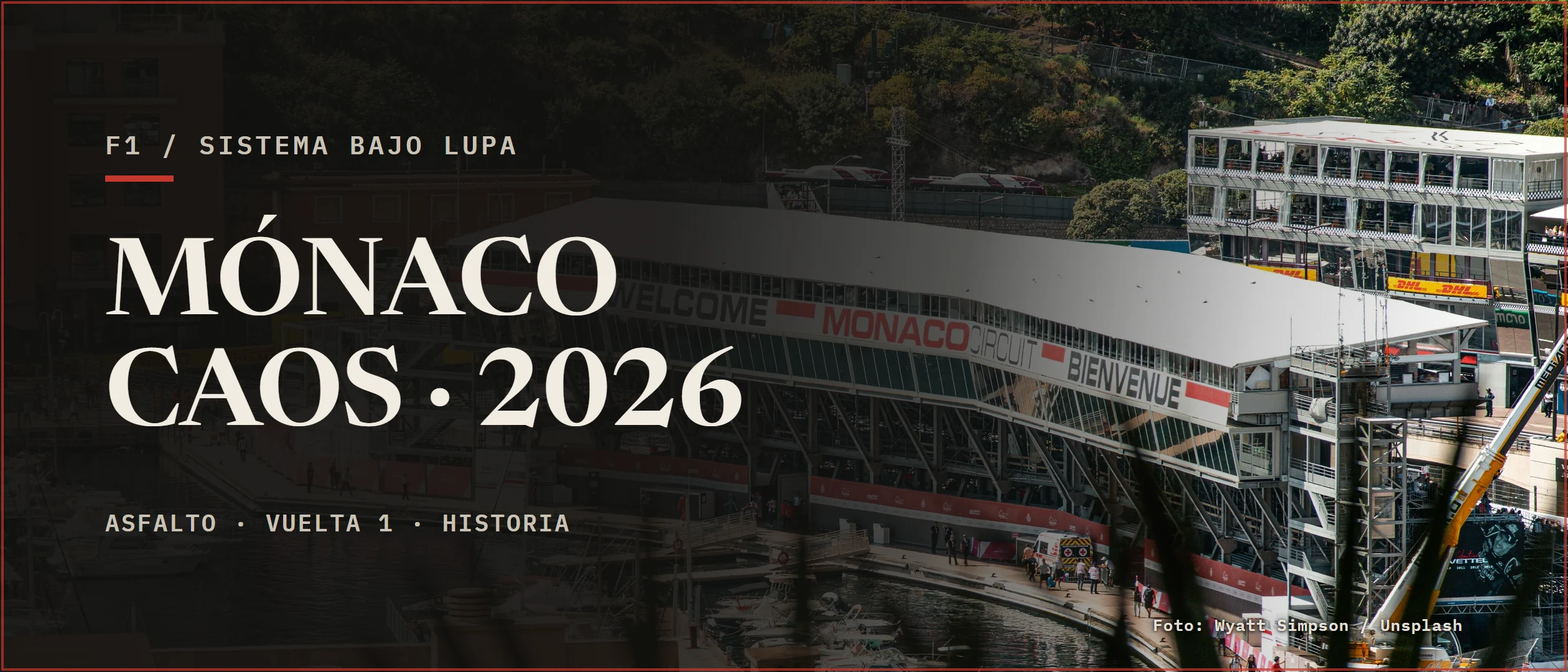
Oye, siéntate. Esto va para largo. Mónaco 2026 fue uno de esos fines de semana donde no sabías si reír, llorar o simplemente tirar el control remoto. Vamos paso a paso.
Contexto rápido
Fecha: 5-7 de junio de 2026 Circuito: Circuit de Monaco (3.337 km, el más corto del calendario) Vueltas: 78 Clima: Soleado, 23 °C ambiente, 29 °C pista Regla clave para 2026: se eliminó la obligación de dos paradas en Mónaco. Ahora es una parada obligatoria como en cualquier otro circuito. Esto cambió TODA la estrategia.
La historia de Leclerc: cuando ni siquiera el asfalto te quiere
Mira, todos hablan de la “maldición de Leclerc en Mónaco”. Y sí, el tipo tiene historial: en 2021 se estrelló en Q3, Ferrari no cambió la caja de cambios, y no arrancó la carrera. En 2022 Ferrari le arruinó la estrategia con la lluvia. En 2023, penalización por bloquear a Norris. En 2024 POR FIN ganó en casa.
Pero ESTE año… oye, ESTE año fue diferente. No fue su culpa. De verdad.
Lo que pasó
Leclerc llegó a Mónaco con un contrato nuevo multianual con Ferrari (anunciado justo antes del fin de semana). En FP1 fue el más rápido. En FP3, aunque Antonelli le ganó, Leclerc estaba ahí. En clasificación hizo P4, no ideal pero tampoco terrible.
En la carrera, estaba tercero. Hamilton segundo. Antonelli primero con una ventaja de casi 30 segundos (sí, leí bien, TREINTA SEGUNDOS en Mónaco). Todo iba más o menos bien.
Lance Stroll se estrelló en la vuelta 60 en la curva final (Turn 19, Anthony Noghès). Safety Car. Todo el mundo a boxes. Reinicio en la vuelta 66.
Leclerc acelera, llega a la misma curva… y se va DERECHO a la barrera. Idéntico a Stroll. Mismo lugar. Mismo ángulo.
Pero aquí viene lo jodido: el asfalto se había desintegrado. La FIA confirmó después que fue un fallo de la pista, no del piloto. Habían repavimentado esa zona recientemente y el asfalto se desmenuzó, dejando “mármol” (escombros de asfalto) justo en la línea de carrera.
Leclerc por radio: “¡Ni siquiera voy a asumir la culpa!”
Y tiene razón. El pobre tipo no pudo ni siquiera intentar ganar en casa porque el circuito literalmente se cayó a pedazos debajo de él.
El dominio de Antonelli: esto ya no es suerte, es talento puro
Vamos a hablar de Kimi Antonelli porque lo que está haciendo este chico de 19 años es simplemente ridículo.
Los números
- Victorias consecutivas: 5 (China, Japón, Miami, Canadá, Mónaco)
- Puntos en el campeonato: 156
- Ventaja sobre Hamilton (2º): 66 puntos
- Ventaja sobre Russell (3º): 68 puntos
- Pole en Mónaco: 1:12.051, superando a Verstappen por 0.043 s
- Vuelta rápida en carrera: sí, también se la llevó
- Récord histórico: ganador más joven de Mónaco con 19 años, 9 meses y 13 días. Superó el récord de Hamilton de 2008.
El análisis técnico
En FP3, Antonelli hizo un 1:12.720 con blandos. Eso fue tres décimas más rápido que Leclerc, quien ya estaba luchando con frenos que él mismo describió como “horrendos”. Russell, su compañero de equipo, estaba a más de dos segundos en FP1. Dos segundos. En Mónaco.
Russell después de clasificar P6: “Nada está funcionando… Me estoy rascando la cabeza. Mi estilo de conducción simplemente no está funcionando con el coche en este momento.”
Esa es la diferencia. Antonelli está extrayendo cosas del W17 que ni siquiera Russell puede encontrar. Y Russell no es un piloto malo, eh. Es un tipo que ha ganado carreras y peleado campeonatos.
En carrera, Antonelli lideró de principio a fin. Pero no fue fácil:
- Tuvo problemas de motor en las subidas desde la vuelta 1.
- El Safety Car de Stroll le recortó una ventaja de casi 30 segundos.
- La bandera roja le obligó a reiniciar desde cero.
- Y aun así, en el reinicio, cubrió a Hamilton en Sainte Dévote y se escapó otra vez.
Terminó 6.2 segundos adelante. En Mónaco. Eso es una eternidad.
“No estaba muy emocionado por reiniciar, pero reuní mis emociones, mis pensamientos, y simplemente intenté reenfocarme. Una vez que salí y mantuve el liderazgo en la primera curva, disfruté las últimas vueltas.” — Kimi Antonelli
Eso de “no estaba emocionado por reiniciar” es clave. El chico tiene 19 años, lidera su primera carrera en Mónaco, le sacan bandera roja a 12 vueltas del final, y su reacción es… bueno, vamos a calmarnos y hacerlo de nuevo. Eso no es normal. Eso es mentalidad de campeón.
Verstappen: el DNF más rápido de la historia
Max Verstappen salió P2. Había clasificado a 0.043 s de Antonelli. La carrera prometía: Mercedes vs. Red Bull en la primera fila, con dos Ferrari justo detrás.
Luces apagadas.
Verstappen… no se mueve. Bueno, se mueve un poco, pero el coche entra en modo anti-stall y se queda prácticamente parado. Veintiún coches lo pasan. Veintiuno. El campeón del mundo, cuatro veces, se queda viendo cómo todo el mundo le pasa por los lados.
Llega a boxes al final de la vuelta 1. Red Bull lo retira.
Después Max explicó: “Terrible. El coche se murió.”
Christian Klien (ex-piloto de Red Bull y F1) no se anduvo con rodeos: “Las revoluciones cayeron completamente en la salida. Ese es un problema fundamental. Con esta nueva generación de coches, si algo falla técnicamente, estás indefenso como piloto. Eso es simplemente peligroso.”
Y aquí está el tema: esto NO es nuevo. En China 2026, Verstappen perdió 11 posiciones combinadas entre el Sprint y la carrera principal por problemas de salida. En Australia también tuvo issues. El RB22 tiene un problema fundamental con el sistema de arranque, probablemente relacionado con la gestión de la batería y el motor eléctrico al final de la vuelta de formación.
Carlos Sainz, director de la GPDA, ya había advertido que las diferencias de velocidad en las salidas podrían causar un accidente grave. En Mónaco, con una recta de salida de solo 142 metros hasta el punto de frenado de la primera curva… bueno, por suerte no hubo un choque en cadena.
Pero Red Bull tiene un problema serio. Verstappen tiene solo 8 puntos en el campeonato después de 6 carreras. Ocho. El año pasado a estas alturas probablemente tenía 120.
Russell y Mercedes: el error que costó una carrera
George Russell llegó a Mónaco segundo en el campeonato, a 43 puntos de Antonelli. No ideal, pero recuperable. Salió P6, no brillante pero tampoco terrible.
Y entonces… bueno, todo se fue al carajo.
La cronología del desastre
- Vuelta 29 (aprox.): Hamilton entra a boxes. Ferrari le cambia a duros en 2.1 segundos. Buena parada.
- Más adelante: Russell también es penalizado con 5 segundos por exceso de velocidad en el pit lane. En Mónaco, el pit lane es especialmente jodido porque no es recto: tienes que girar a la derecha después de la entrada, luego a la izquierda, y otra izquierda antes de la salida. Si cortas mucho las curvas, los sensores de la FIA detectan que pasaste menos tiempo entre los loops de cronometraje, y te penalizan.
- Safety Car (vuelta 60): Stroll se estrella. Todo el mundo entra a boxes. Momento PERFECTO para servir penalizaciones.
- El error: Mercedes NO hizo esperar a Russell los 5 segundos en su pit box. Le cambiaron las ruedas normalmente.
- Consecuencia: como la penalización no fue “servida” correctamente, los comisarios la convirtieron en un drive-through penalty.
- Vuelta 73: Russell entra a boxes, atraviesa el pit lane, vuelve a salir. Del P3 cae al P12. Sin puntos.
Russell después: “Más allá de la frustración.”
Esto es especialmente doloroso porque Russell estaba presionando a Hadjar durante toda la carrera. Tenía ritmo para al menos un podio, probablemente. Y un error operativo del equipo lo dejó fuera de los puntos.
Y no es la primera vez. En Canadá 2026, Russell lideraba desde la pole y se retiró por fallo eléctrico. Tiró el reposacabezas a la pista de la frustración. El chico está teniendo una racha de mala suerte (y errores del equipo) que podría costarle el campeonato.
Clasificación del campeonato tras Mónaco:
| Pos | Piloto | Puntos | Diferencia con líder |
|---|---|---|---|
| 1º | Kimi Antonelli | 156 | — |
| 2º | Lewis Hamilton | 90 | -66 |
| 3º | George Russell | 88 | -68 |
Antonelli tiene casi el DOBLE de puntos que Russell. A mitad de temporada, eso es una montaña.
Hadjar: primer podio con el coche roto desde la vuelta 10
Isack Hadjar, el rookie francés de Red Bull, tuvo un fin de semana de locos.
- Viernes (FP1): se estrella en la chicane de la piscina. Red Bull tiene que reconstruir el coche.
- Sábado: clasifica P5, superando a Russell.
- Domingo: logra su primer podio en F1… pero con problemas de “driveability” (manejabilidad) desde la vuelta 10.
Hadjar después de la carrera: “Dentro de las primeras 10-15 vueltas empecé a tener problemas masivos de driveability. Si hay un circuito donde no quieres eso, es aquí. Fue masivamente desafiante, incluso al final me faltaba potencia en el reinicio.”
A pesar de eso, mantuvo la calma. En el reinicio tras la bandera roja, perdió dos posiciones (Russell y Gasly lo pasaron), pero luego Russell fue a cumplir su drive-through, Gasly recibió dos penalizaciones de 5 segundos por exceso de velocidad en boxes (sí, dos veces), y Hadjar recuperó el P3.
Es un podio que sabe a gloria para Red Bull, especialmente considerando que Verstappen no completó ni una vuelta. Y para Hadjar, es una demostración de madurez. Muchos rookies se habrían desmoronado con esos problemas en Mónaco.
Análisis técnico profundo: estrategias, neumáticos y por qué Mónaco 2026 fue diferente
El cambio de reglas que nadie esperaba
En 2025, Mónaco tenía una regla especial: dos paradas obligatorias. Eso obligaba a estrategias agresivas y, en teoría, más acción. Pero en la práctica, dos equipos (Racing Bulls y Williams) la explotaron usando un coche para bloquear al resto mientras el otro hacía sus paradas.
Para 2026, la FIA eliminó esa regla. Ahora es una parada obligatoria como en cualquier otro circuito. Y eso cambió la dinámica:
- Estrategia dominante: medio → duro (la mayoría).
- Excepciones: Bortoleto, Pérez y Bottas salieron con blandos.
- Tiempo perdido en boxes en Mónaco: 19.92 segundos (incluyendo 2.5 s de parada). Eso es casi el doble que en Monza.
La estrategia de Hamilton: penalización y resistencia
Hamilton recibió 5 segundos por exceso de velocidad en el pit lane. Pero a diferencia de Russell, Ferrari LO EJECUTÓ correctamente durante la parada bajo Safety Car. Hamilton entró, esperó 5 segundos inmóvil, luego le cambiaron ruedas.
Eso le costó posiciones en pista, pero no una penalización posterior. Terminó P2, a 6.2 segundos de Antonelli. Considerando que tuvo que gestionar neumáticos duros durante casi 50 vueltas y lidiar con la penalización, es un resultado sólido.
Hamilton después: “Tengo que empezar felicitando a Kimi y a mi antiguo equipo Mercedes. Kimi está entregando fin de semana tras fin de semana. Nosotros hemos estado progresando, pero todavía no podemos seguirles el ritmo. Necesitamos más downforce.”
El beneficio inesperado: Arvid Lindblad
Lindblad (Racing Bulls) no había hecho su parada cuando salió el Safety Car. Bajo bandera roja, todos pudieron cambiar neumáticos gratis. Lindblad, que había estado fuera de los puntos, terminó P6. Básicamente, la bandera roja le regaló una parada.
Los problemas de frenos en Ferrari
Leclerc reportó frenos “horrendos” en FP3. En clasificación, Hamilton también tuvo un lock-up masivo en Sainte Dévote, yendo por la escapatoria. Ferrari claramente tenía un problema de balance de frenos en el SF-26 en Mónaco.
Esto es técnicamente interesante porque Mónaco es un circuito de baja velocidad con MUCHO frenado. Si tus frenos no están consistentes, pierdes tiempo en cada curva. Y en un circuito donde la diferencia entre pole y P4 es 0.7 segundos, eso es fatal.
TODAS las penalizaciones del fin de semana (porque fueron muchas)
Mónaco 2026 fue un festival para los comisarios. Aquí está la lista completa:
| Piloto | Infracción | Sanción | Resultado |
|---|---|---|---|
| Lewis Hamilton | Exceso de velocidad en pit lane | 5 segundos | Servido en boxes bajo SC |
| George Russell | Exceso de velocidad en pit lane | 5 s → NO servido → drive-through | Cayó del P3 al P12 |
| Pierre Gasly | Exceso de velocidad en pit lane (2 veces) | Dos × 5 s = 10 segundos | Cayó del P3 al P7 |
| Franco Colapinto | Exceso de velocidad en pit lane | 5 segundos | Aplicado al tiempo final |
| Oscar Piastri | Exceso de velocidad en pit lane | 5 segundos | Aplicado al tiempo final |
| Sergio Pérez | Posición incorrecta en la parrilla de salida | Drive-through | Inicialmente P10, luego penalizado |
| Sergio Pérez | Posición incorrecta en el reinicio tras bandera roja | 10 segundos | Cayó del P10 al P15 |
| Nico Hülkenberg | Causar colisión con Sainz | 10 segundos | Aplicado al tiempo final |
Alpine presentó un derecho de apelación contra las penalizaciones de Gasly. No sé si prosperará, pero el equipo está claramente frustrado.
Resultados completos del GP de Mónaco 2026
| Pos | Piloto | Equipo | Notas |
|---|---|---|---|
| 1º | Kimi Antonelli | Mercedes | Pole, victoria, vuelta rápida. Hat-trick. |
| 2º | Lewis Hamilton | Ferrari | +6.2 s, gestionó penalización de 5 s |
| 3º | Isack Hadjar | Red Bull | Primer podio en F1, con problemas de motor |
| 4º | Oscar Piastri | McLaren | Único McLaren en carrera, sólido P4 |
| 5º | Liam Lawson | Racing Bulls | Buena carrera desde P10 |
| 6º | Arvid Lindblad | Racing Bulls | Beneficiado por la bandera roja (parada gratis) |
| 7º | Pierre Gasly | Alpine | Cruzó la meta P3, pero dos penalizaciones lo mandaron al P7 |
| 8º | Alex Albon | Williams | Único Williams en puntos |
| 9º | Esteban Ocon | Haas | Carrera limpia |
| 10º | Sergio Pérez | Cadillac | Inicialmente P10, luego penalizado, luego… bueno, al menos terminó |
| 11º | Fernando Alonso | Aston Martin | Primera vez en puntos para Aston Martin en 2026 |
| 12º | Gabriel Bortoleto | Audi | Desde pit lane (se quedó parado en la salida de boxes antes de la carrera) |
| 13º | George Russell | Mercedes | Drive-through penalty, sin puntos |
| 14º | Nico Hülkenberg | Audi | Penalizado por colisión con Sainz |
| 15º | Franco Colapinto | Alpine | Penalizado por exceso de velocidad en boxes |
DNF (no terminaron):
- Carlos Sainz (Williams): golpeado por Hülkenberg en la horquilla, luego por Colapinto en Portier.
- Charles Leclerc (Ferrari): estrellado por fallo de asfalto en Turn 19.
- Lance Stroll (Aston Martin): estrellado en Turn 19 (el que empezó todo).
- Lando Norris (McLaren): problemas de potencia, retirado.
- Oliver Bearman (Haas): contacto con Ocon en la salida, daño en alerón delantero, retirado después.
- Valtteri Bottas (Cadillac): problemas de frenos (de nuevo), retirado.
- Max Verstappen (Red Bull): fallo en la salida, retirado en vuelta 1.
Momentos random que no te puedes perder
El “save” de Norris en FP1
En la primera práctica, Norris tuvo un momento feo pero logró salvarlo. Luego en FP2 se quedó parado a los 15 minutos. McLaren rompió el toque de queda para cambiar el harness de cableado y el pack ESME. Luego en la carrera… se retiró por problemas de potencia. McLaren está teniendo un año complicado.
Los Haas peleándose en FP1
Ocon y Bearman se estaban quejando uno del otro por radio en la primera práctica. Ocon decía que Bearman le frenaba demasiado. Bearman decía que Ocon se posicionaba mal. En la carrera… Bearman chocó con Ocon en la salida. Ironía nivel: experto.
Cadillac y los frenos en llamas
En FP2, Pérez tuvo un incendio en los frenos que provocó bandera roja. En FP3, Bottas tuvo humo saliendo de los frenos. En la carrera, Bottas se retiró por problemas de frenos. Cadillac tiene un problema serio con el sistema de frenos en el MAC-26.
Lindblad y Lawson sin ángulo de giro
Ambos pilotos de Racing Bulls se quejaron en FP1 de que no tenían “suficiente lock” (ángulo de giro) para pasar la horquilla. Es decir, el coche no giraba lo suficiente para una de las curvas más lentas del calendario. Eso es un problema de diseño serio.
¿Y ahora qué? El campeonato se pone interesante (o no)
Antonelli tiene 156 puntos. Hamilton 90. Russell 88.
La pregunta no es si Antonelli ganará el campeonato. La pregunta es cuándo lo sellará matemáticamente.
Con 16 carreras restantes, Russell necesitaría ganar prácticamente todas y que Antonelli no sume en ninguna. Eso no va a pasar.
Pero hay cosas interesantes para seguir:
- Ferrari está mejorando. Hamilton ha subido al podio en las últimas carreras. Leclerc, cuando no se estrella por asfalto defectuoso, tiene ritmo.
- Red Bull tiene que arreglar sus problemas de fiabilidad. Verstappen no puede seguir sin sumar.
- McLaren está en crisis. Norris, que defendía el campeonato, ha tenido problemas en casi todas las carreras.
- Mercedes tiene el coche más rápido, pero Russell no puede extraerle el rendimiento que sí encuentra Antonelli.
Lo que está claro es que 2026 está siendo el año de Kimi Antonelli.
Eso es todo, amigo. Mónaco 2026 fue un circo. Un circo hermoso, caótico, y con un chico de 19 años haciendo historia. Nos vemos en la siguiente.
Fuentes: Formula1.com, Coffee Corner Motorsport, Pit Debrief, Detik Sport, GPBlog, RacingNews365.
Hey, sit down. This is gonna be a long one. Monaco 2026 was one of those weekends where you didn’t know whether to laugh, cry, or just throw the remote. Let’s take it step by step.
Quick context
Date: June 5-7, 2026 Circuit: Circuit de Monaco (3.337 km, the shortest on the calendar) Laps: 78 Weather: Sunny, 23 °C air, 29 °C track Key rule for 2026: the mandatory two-stop rule at Monaco was scrapped. It’s now a single mandatory stop, like any other circuit. That changed EVERYTHING about strategy.
The Leclerc story: when even the asphalt doesn’t want you
Look, everybody talks about the “Leclerc Monaco curse.” And sure, the guy has history: in 2021 he crashed in Q3, Ferrari didn’t change the gearbox, and he didn’t start the race. In 2022 Ferrari wrecked his strategy in the rain. In 2023, a penalty for blocking Norris. In 2024 he FINALLY won at home.
But THIS year… hey, THIS year was different. It wasn’t his fault. Really.
What happened
Leclerc arrived in Monaco with a new multi-year Ferrari contract (announced right before the weekend). In FP1 he was fastest. In FP3, even though Antonelli beat him, Leclerc was right there. In qualifying he managed P4 — not ideal, but not terrible either.
In the race, he was third. Hamilton second. Antonelli first with a lead of almost 30 seconds (yes, you read that right, THIRTY SECONDS at Monaco). Everything was going more or less fine.
Lance Stroll crashed on lap 60 at the final corner (Turn 19, Anthony Noghès). Safety Car. Everyone to the pits. Restart on lap 66.
Leclerc gets on the throttle, reaches the same corner… and goes STRAIGHT into the barrier. Identical to Stroll. Same place. Same angle.
But here’s the messed-up part: the asphalt had disintegrated. The FIA confirmed afterward that it was a track failure, not the driver. They had recently resurfaced that section, and the asphalt crumbled, leaving “marbles” (asphalt debris) right on the racing line.
Leclerc on the radio: “I’m not even going to take the blame!”
And he’s right. The poor guy couldn’t even try to win at home because the circuit literally fell apart underneath him.
Antonelli’s dominance: this isn’t luck anymore, it’s pure talent
Let’s talk about Kimi Antonelli, because what this 19-year-old kid is doing is just ridiculous.
The numbers
- Consecutive wins: 5 (China, Japan, Miami, Canada, Monaco)
- Championship points: 156
- Lead over Hamilton (2nd): 66 points
- Lead over Russell (3rd): 68 points
- Monaco pole: 1:12.051, beating Verstappen by 0.043 s
- Fastest lap in the race: yep, took that too
- Historic record: youngest Monaco winner at 19 years, 9 months and 13 days. He broke Hamilton’s 2008 record.
The technical breakdown
In FP3, Antonelli posted a 1:12.720 on softs. That was three tenths faster than Leclerc, who was already fighting brakes he himself described as “horrendous.” Russell, his teammate, was more than two seconds off in FP1. Two seconds. At Monaco.
Russell after qualifying P6: “Nothing is working… I’m scratching my head. My driving style just isn’t working with the car right now.”
That’s the difference. Antonelli is pulling things out of the W17 that not even Russell can find. And Russell is no bad driver, mind you. He’s a guy who has won races and fought for championships.
In the race, Antonelli led from start to finish. But it wasn’t easy:
- He had engine trouble on the climbs from lap 1.
- Stroll’s Safety Car wiped out a lead of almost 30 seconds.
- The red flag forced him to restart from scratch.
- And even so, on the restart, he covered Hamilton into Sainte Dévote and pulled away again.
He finished 6.2 seconds clear. At Monaco. That’s an eternity.
“I wasn’t too excited about the restart, but I gathered my emotions, my thoughts, and just tried to refocus. Once I got going and held the lead into the first corner, I enjoyed the last few laps.” — Kimi Antonelli
That “I wasn’t excited about the restart” line is key. The kid is 19, leading his first Monaco, gets a red flag with 12 laps to go, and his reaction is… well, let’s calm down and do it again. That’s not normal. That’s a champion’s mindset.
Verstappen: the fastest DNF in history
Max Verstappen started P2. He had qualified 0.043 s off Antonelli. The race looked promising: Mercedes vs. Red Bull on the front row, with two Ferraris right behind.
Lights out.
Verstappen… doesn’t move. Well, he moves a little, but the car goes into anti-stall and basically sits there. Twenty-one cars go past him. Twenty-one. The four-time world champion stands there watching everyone stream past on both sides.
He reaches the pits at the end of lap 1. Red Bull retires him.
Max explained afterward: “Terrible. The car died.”
Christian Klien (former Red Bull and F1 driver) didn’t mince words: “The revs dropped completely at the launch. That’s a fundamental problem. With this new generation of cars, if something fails technically, you’re helpless as a driver. That’s just dangerous.”
And here’s the thing: this is NOT new. In China 2026, Verstappen lost 11 combined positions between the Sprint and the main race due to launch problems. In Australia he had issues too. The RB22 has a fundamental problem with its launch system, probably related to battery and electric-motor management at the end of the formation lap.
Carlos Sainz, the GPDA director, had already warned that speed differences off the line could cause a serious accident. At Monaco, with a starting straight of only 142 meters to the braking point for Turn 1… well, luckily there was no pile-up.
But Red Bull has a serious problem. Verstappen has only 8 points in the championship after 6 races. Eight. Last year at this point he probably had 120.
Russell and Mercedes: the mistake that cost a race
George Russell arrived in Monaco second in the championship, 43 points behind Antonelli. Not ideal, but recoverable. He started P6 — not brilliant, but not terrible either.
And then… well, it all went sideways.
The timeline of the disaster
- Lap 29 (approx.): Hamilton pits. Ferrari switches him to hards in 2.1 seconds. Good stop.
- Later: Russell is also handed a 5-second penalty for speeding in the pit lane. At Monaco, the pit lane is especially nasty because it isn’t straight: you have to turn right after the entry, then left, then another left before the exit. If you cut the corners too much, the FIA sensors detect that you spent less time between the timing loops, and they penalize you.
- Safety Car (lap 60): Stroll crashes. Everyone pits. The PERFECT moment to serve penalties.
- The mistake: Mercedes did NOT make Russell wait the 5 seconds in his pit box. They changed his tires normally.
- The consequence: because the penalty wasn’t “served” correctly, the stewards converted it into a drive-through penalty.
- Lap 73: Russell pits, drives through the pit lane, comes back out. He drops from P3 to P12. No points.
Russell afterward: “Beyond frustrating.”
This one stings especially because Russell had been pressuring Hadjar the whole race. He had the pace for at least a podium, probably. And an operational error by the team left him out of the points.
And it’s not the first time. In Canada 2026, Russell was leading from pole and retired with an electrical failure. He threw his headrest onto the track in frustration. The kid is on a streak of bad luck (and team errors) that could cost him the championship.
Championship standings after Monaco:
| Pos | Driver | Points | Gap to leader |
|---|---|---|---|
| 1st | Kimi Antonelli | 156 | — |
| 2nd | Lewis Hamilton | 90 | -66 |
| 3rd | George Russell | 88 | -68 |
Antonelli has nearly DOUBLE Russell’s points. At mid-season, that’s a mountain.
Hadjar: first podium with a broken car since lap 10
Isack Hadjar, the French Red Bull rookie, had a wild weekend.
- Friday (FP1): crashes at the swimming-pool chicane. Red Bull has to rebuild the car.
- Saturday: qualifies P5, beating Russell.
- Sunday: scores his first F1 podium… but with “driveability” problems from lap 10.
Hadjar after the race: “Within the first 10-15 laps I started having massive driveability problems. If there’s one circuit where you don’t want that, it’s here. It was massively challenging — even at the end I was short on power at the restart.”
Despite that, he kept his cool. On the restart after the red flag, he lost two positions (Russell and Gasly passed him), but then Russell went off to serve his drive-through, Gasly picked up two 5-second penalties for pit-lane speeding (yes, twice), and Hadjar got P3 back.
It’s a podium that tastes like glory for Red Bull, especially considering Verstappen didn’t complete a single lap. And for Hadjar, it’s a show of maturity. Plenty of rookies would have crumbled with those problems at Monaco.
Deep technical analysis: strategy, tires and why Monaco 2026 was different
The rule change nobody expected
In 2025, Monaco had a special rule: two mandatory stops. That forced aggressive strategies and, in theory, more action. But in practice, two teams (Racing Bulls and Williams) exploited it by using one car to block the rest while the other made its stops.
For 2026, the FIA scrapped that rule. It’s now a single mandatory stop, like any other circuit. And that changed the dynamic:
- Dominant strategy: medium → hard (most of the field).
- Exceptions: Bortoleto, Pérez and Bottas started on softs.
- Pit-lane time loss at Monaco: 19.92 seconds (including a 2.5 s stop). That’s almost double Monza.
Hamilton’s strategy: penalty and endurance
Hamilton got 5 seconds for pit-lane speeding. But unlike Russell, Ferrari EXECUTED it correctly during the stop under the Safety Car. Hamilton came in, waited 5 seconds stationary, then got his tires changed.
That cost him track position, but no subsequent penalty. He finished P2, 6.2 seconds behind Antonelli. Considering he had to manage hard tires for almost 50 laps and deal with the penalty, it’s a solid result.
Hamilton afterward: “I have to start by congratulating Kimi and my old team Mercedes. Kimi is delivering weekend after weekend. We’ve been making progress, but we still can’t match their pace. We need more downforce.”
The unexpected windfall: Arvid Lindblad
Lindblad (Racing Bulls) hadn’t made his stop when the Safety Car came out. Under the red flag, everyone got to change tires for free. Lindblad, who had been out of the points, finished P6. Basically, the red flag gifted him a stop.
Ferrari’s brake problems
Leclerc reported “horrendous” brakes in FP3. In qualifying, Hamilton also had a massive lock-up at Sainte Dévote, going down the escape road. Ferrari clearly had a brake-balance problem with the SF-26 at Monaco.
This is technically interesting because Monaco is a low-speed circuit with LOTS of braking. If your brakes aren’t consistent, you lose time in every corner. And on a track where the gap between pole and P4 is 0.7 seconds, that’s fatal.
ALL the penalties of the weekend (because there were a lot)
Monaco 2026 was a festival for the stewards. Here’s the full list:
| Driver | Infraction | Sanction | Outcome |
|---|---|---|---|
| Lewis Hamilton | Pit-lane speeding | 5 seconds | Served in the pits under SC |
| George Russell | Pit-lane speeding | 5 s → NOT served → drive-through | Dropped from P3 to P12 |
| Pierre Gasly | Pit-lane speeding (twice) | Two × 5 s = 10 seconds | Dropped from P3 to P7 |
| Franco Colapinto | Pit-lane speeding | 5 seconds | Applied to final time |
| Oscar Piastri | Pit-lane speeding | 5 seconds | Applied to final time |
| Sergio Pérez | Wrong starting-grid position | Drive-through | Initially P10, then penalized |
| Sergio Pérez | Wrong position at the post-red-flag restart | 10 seconds | Dropped from P10 to P15 |
| Nico Hülkenberg | Causing a collision with Sainz | 10 seconds | Applied to final time |
Alpine filed a right of appeal against Gasly’s penalties. I don’t know if it’ll succeed, but the team is clearly frustrated.
Full results of the 2026 Monaco GP
| Pos | Driver | Team | Notes |
|---|---|---|---|
| 1st | Kimi Antonelli | Mercedes | Pole, win, fastest lap. Hat-trick. |
| 2nd | Lewis Hamilton | Ferrari | +6.2 s, managed a 5 s penalty |
| 3rd | Isack Hadjar | Red Bull | First F1 podium, with engine trouble |
| 4th | Oscar Piastri | McLaren | Only McLaren running, solid P4 |
| 5th | Liam Lawson | Racing Bulls | Good race from P10 |
| 6th | Arvid Lindblad | Racing Bulls | Helped by the red flag (free stop) |
| 7th | Pierre Gasly | Alpine | Crossed the line P3, but two penalties dropped him to P7 |
| 8th | Alex Albon | Williams | Only Williams in the points |
| 9th | Esteban Ocon | Haas | Clean race |
| 10th | Sergio Pérez | Cadillac | Initially P10, then penalized, then… well, at least he finished |
| 11th | Fernando Alonso | Aston Martin | First points for Aston Martin in 2026 |
| 12th | Gabriel Bortoleto | Audi | From the pit lane (stalled at the pit exit before the race) |
| 13th | George Russell | Mercedes | Drive-through penalty, no points |
| 14th | Nico Hülkenberg | Audi | Penalized for the collision with Sainz |
| 15th | Franco Colapinto | Alpine | Penalized for pit-lane speeding |
DNF (did not finish):
- Carlos Sainz (Williams): hit by Hülkenberg at the hairpin, then by Colapinto at Portier.
- Charles Leclerc (Ferrari): crashed due to an asphalt failure at Turn 19.
- Lance Stroll (Aston Martin): crashed at Turn 19 (the one who started it all).
- Lando Norris (McLaren): power problems, retired.
- Oliver Bearman (Haas): contact with Ocon at the start, front-wing damage, retired later.
- Valtteri Bottas (Cadillac): brake problems (again), retired.
- Max Verstappen (Red Bull): launch failure, retired on lap 1.
Random moments you can’t miss
Norris’s “save” in FP1
In the first practice, Norris had an ugly moment but managed to save it. Then in FP2 he stopped on track after 15 minutes. McLaren broke curfew to change the wiring harness and the ESME pack. Then in the race… he retired with power problems. McLaren is having a rough year.
The Haas drivers bickering in FP1
Ocon and Bearman were complaining about each other on the radio in the first practice. Ocon said Bearman was braking too much in front of him. Bearman said Ocon was positioning himself badly. In the race… Bearman crashed into Ocon at the start. Irony level: expert.
Cadillac and the brakes on fire
In FP2, Pérez had a brake fire that brought out a red flag. In FP3, Bottas had smoke pouring off his brakes. In the race, Bottas retired with brake problems. Cadillac has a serious problem with the braking system on the MAC-26.
Lindblad and Lawson with no steering lock
Both Racing Bulls drivers complained in FP1 that they didn’t have “enough lock” (steering angle) to get around the hairpin. Meaning the car wouldn’t turn enough for one of the slowest corners on the calendar. That’s a serious design problem.
So what now? The championship gets interesting (or not)
Antonelli has 156 points. Hamilton 90. Russell 88.
The question isn’t whether Antonelli will win the championship. The question is when he’ll seal it mathematically.
With 16 races left, Russell would need to win practically all of them and have Antonelli score nothing. That’s not going to happen.
But there are interesting things to follow:
- Ferrari is improving. Hamilton has been on the podium in recent races. Leclerc, when he isn’t crashing because of faulty asphalt, has the pace.
- Red Bull has to fix its reliability problems. Verstappen can’t keep going without scoring.
- McLaren is in crisis. Norris, the reigning title contender, has had problems in nearly every race.
- Mercedes has the fastest car, but Russell can’t extract the performance that Antonelli finds.
What’s clear is that 2026 is shaping up to be the year of Kimi Antonelli.
That’s all, friend. Monaco 2026 was a circus. A beautiful, chaotic circus, with a 19-year-old kid making history. See you at the next one.
Sources: Formula1.com, Coffee Corner Motorsport, Pit Debrief, Detik Sport, GPBlog, RacingNews365.